How the Combo Works in Every Aura Games Lab Game
Six of our originals put most of their score inside a combo system, and no two of those systems behave the same way. Some show you a multiplier that caps. One shows a number that never stops climbing. Two never print a number at all. A break might come from a clock, a single misplaced pixel, or the hit that ends your run. We wrote each one on purpose, so treat this as the map across all of them: what the multiplier is really worth, what kills it, and the habit that keeps it alive. The per-game tips posts go deep on each. This one stays wide.
The two families: a number you watch, or a streak you feel
Sort them into two camps before anything else, because it changes how you play.
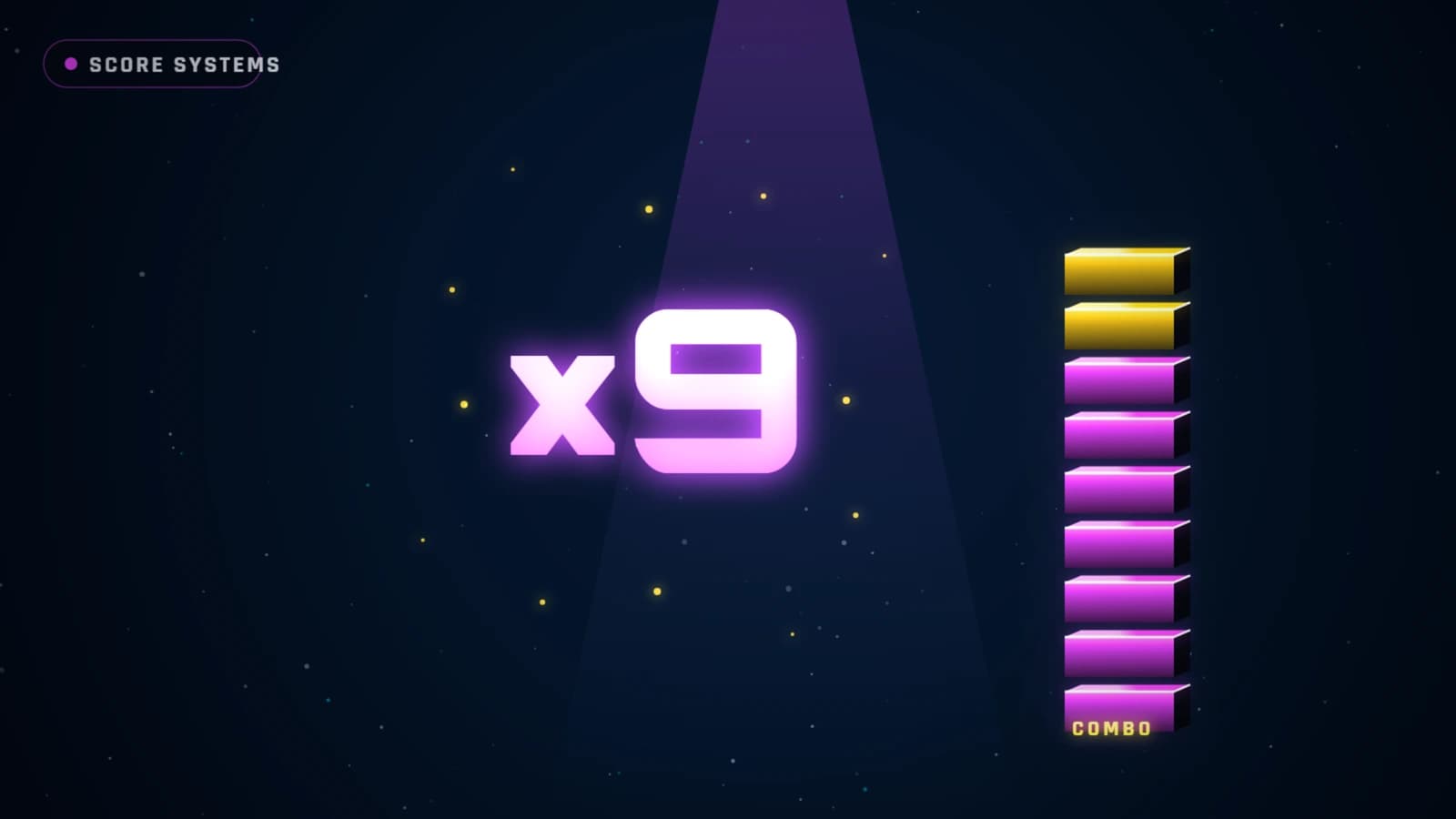
Four games hand you a multiplier that climbs on screen. Nova and Aura Dash both stop at x9. Ionizer stops at eight. Pest Wipeout is the outlier that never caps. The last two, Neon Stack and Flux, never print a multiplier at all. They run streaks instead, where each clean action pays more than the one before and a single slip drops you to nothing. You feel those rather than read them, which is a design choice we're proud of and, honestly, one we undersold. Plenty of Flux players finish a run without ever noticing the game had a skill layer.
So the job splits. In the four number games you climb to the cap and camp there. In the two streak games there's no cap to camp at, only a chain you refuse to break.
What each combo is actually worth
Numbers, because vague is useless here.
Ionizer has the most violent multiplier on the site. It counts every block you shatter since the ball last kissed the paddle, up to a cap of eight, which turns one 10-point block into 80. Hit a six-chain and the whole field tips into an overdrive bloom while the ion burns hot orange instead of cool cyan. That colour is your readout when you can't spare a glance for the score.
Nova stacks two multipliers on each other. Base score is 5 times your combo, the combo caps at x9, and a gold target triples whatever you'd have scored, so a gold popped on a maxed streak is 135 points from a single tap. There's a quieter third layer. Hit an ordinary target inside the narrow perfect window, between 15% and 30% of its life, just after it reaches full size at 18%, and you bank double. Nothing on screen marks that window, which is a communication miss we own. It's there for anyone who learns to feel it.
Aura Dash pays 12 points per orb times your multiplier, plus a passive trickle every frame that also scales with the combo. A run's value is mostly time spent pinned near x9, not any single grab. Reach x9 and OVERDRIVE trips: the grab radius jumps 34 pixels and orbs magnetise into the core, so the cap gets easier to hold the moment you arrive.
Pest Wipeout is the one with no ceiling. Each pest pays its base, 6 for a mosquito up to 22 for an armored roach, times a combo that keeps multiplying as long as you stay clean. A tidy wave is worth many times a sloppy one, and the reward never stops growing.
Neon Stack and Flux both pay compounding streaks. A Neon Stack perfect is worth 1 plus your current combo, so five clean drops in a row bury any single lucky one. Flux works the same way on its perfect-thread, where five centred passes compound into a bonus that dwarfs an entire run of wide, safe flying.
What kills each one
Every combo has exactly one break condition. Learn it and you're most of the way home.
Aura Dash runs on a clock. The multiplier bleeds back toward x1 if you go roughly two and a half seconds without collecting an orb. You can't sprint to x9 and hide there. The skill is a steady rhythm of pickups while the arena tries to kill you, which is why our Aura Dash guide is really a routing lesson.
Ionizer resets the moment the ball comes home. The chain zeroes the instant the ion touches your paddle, and you can't hold the ball up on purpose. You set an angle off the paddle and hope it keeps chewing the wall before it sinks. We'll say it plainly: the biggest Ionizer multipliers are more a reward you notice than a lever you fully control. Angle for corners and long horizontal runs across the brick face to buy airtime.
A hit in Pest Wipeout costs you twice. It takes a life, wipes the combo, and knocks your weapon down two levels in the same beat. That's the level-loss spiral we spend our Pest Wipeout tips warning about: one clip in a busy late wave leaves you weaker, which makes the next hit likelier. We softened it with 1.2 seconds of blinking invulnerability after each hit and a bug-shield you can grab, but a clean wave is worth defending like your run depends on it, because it does.
Neon Stack comes down to 6 pixels. Drop within 6px of dead-centre and the slab snaps flush, hands back up to 4px of lost width, and bumps the combo. Miss it and the combo falls to zero while the tower narrows. Speed climbs from 3.4px a frame to a hard cap of 8.5, so by slab 40 that window is barely wider than a single frame. Our own tip is to release a hair before the slab looks centred, because late in a run you're outrunning your reaction lag. There's more in the Neon Stack guide.
Flux hangs on the centre band. Clear a gate within 20% of the gap's centre and the streak grows; drift off by a hair and it snaps to zero. The trap we built on purpose: the gaps pinch from 210px down to a 132px floor, so the tightest gates are exactly where the centre band is thinnest and the urge to hug it bites hardest. Fly wide and live, or thread the line and get rich. Flux is built around that choice.
Nova is the soft one. A missed tap into empty space resets your combo but never costs a life. Whiffing is free apart from the streak, so you can hunt targets aggressively without dying for a mistake. Sweep the field in a rough order instead of stabbing at whatever your eye catches first. The Nova tips go further.
One habit that carries across all six
The thread tying these together is greed management. Every combo we built pays more the longer you hold it and costs you the second you slip; the games only differ in what slipping means. The players who post top scores aren't the ones with the fastest hands. They're the ones who worked out that the break condition is the whole game, and who keep taking small risks to feed a streak instead of playing safe and wondering where the points went.
If you want the reasoning behind why all six lean this hard on feel and feedback, we wrote about how we rebuilt the way our games feel. Otherwise, pick one and go find the cap. Aura Dash if you want the clock. Ionizer for the wall. Or Pest Wipeout, the only combo here with no ceiling to reach.
Frequently asked questions
Do all your games cap the combo at the same number?+
No, and the difference matters. Nova and Aura Dash both hard-cap at x9. Ionizer caps at eight. Pest Wipeout never caps at all, so a long clean wave keeps compounding. Neon Stack and Flux don't show a multiplier number at all; they run streak systems where each clean hit pays more than the last.
Which of your games has the most forgiving combo?+
Nova. A missed tap into empty space resets your combo but never costs a life, so you can chase the streak aggressively without dying for a mistake. The harshest are Aura Dash and Pest Wipeout, where the same instant that drops your combo can also end the run.
What actually breaks my combo in each game?+
A clock in Aura Dash (about 2.5 seconds without an orb), the ball touching your paddle in Ionizer, a taken hit in Pest Wipeout, missing the 6px centre in Neon Stack, drifting off the 20% centre band in Flux, and whiffing into empty space in Nova. Learn the break condition and you're most of the way to holding the streak.
Is chasing the combo worth the risk?+
Almost always, because the scaling is steep. A single Ionizer block jumps from 10 points to 80 at max chain. A gold Nova target on a maxed streak is 135 points in one tap. The score you leave on the table by playing safe is far larger than most players guess.