Voltex: How to Hold the Grid (Tips from the Studio)
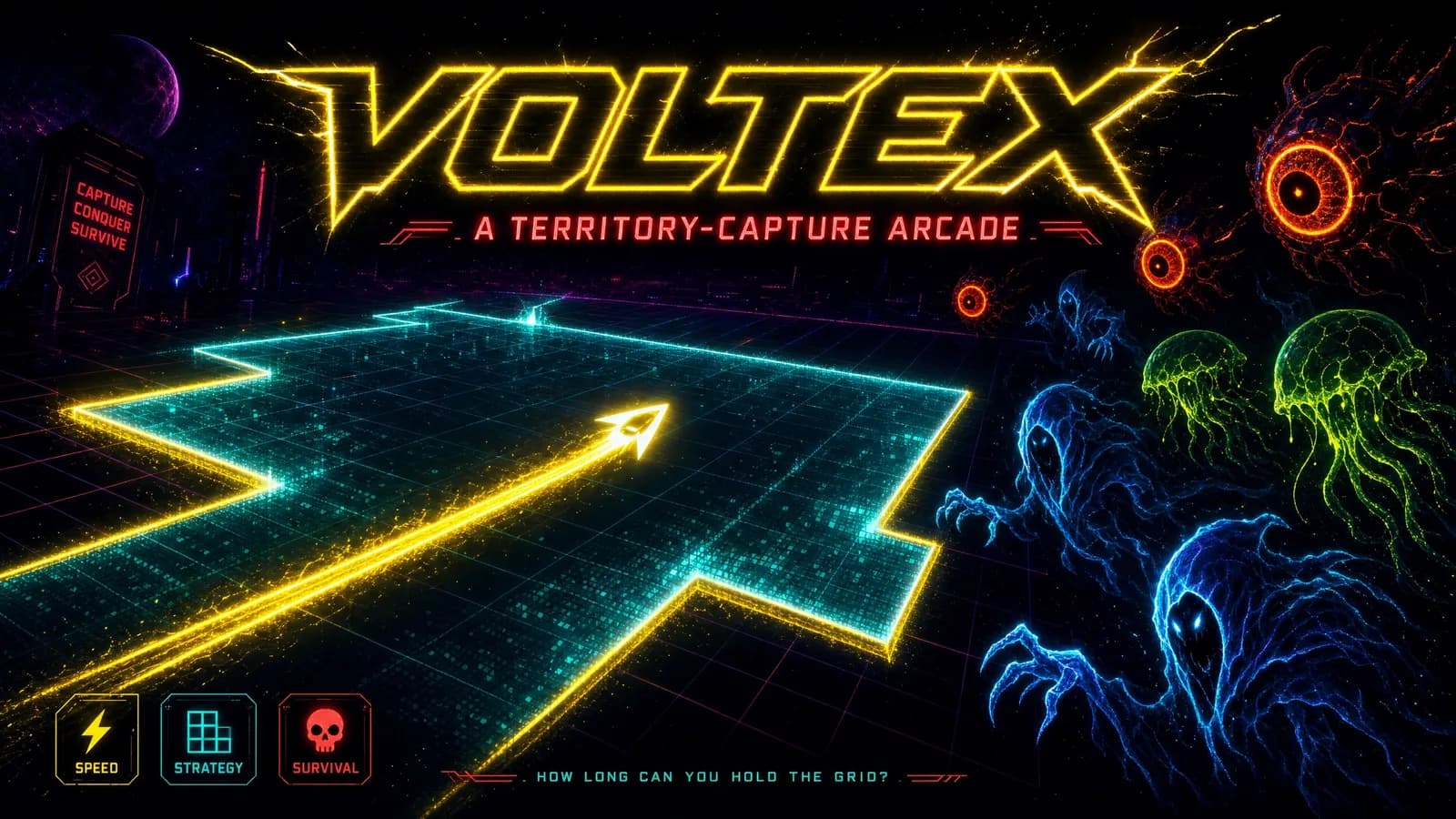
Voltex is a game about drawing a line and then getting greedy about it. You steer a point around a neon grid, pushing a light-trail out into ground you don't own yet. Close that trail back to territory you already hold and everything you fenced off flips to yours. Easy to describe. The catch is that while your trail is out in the open, it is the one part of you that can die: any monster on the board ends your run by touching that line a single time. So every capture is a small wager on whether you can get home before something crosses it.
Claim in small bites
The one habit that separates a clean run from a furious one is bite size. Take little slivers of the grid instead of one grand sweep. A large capture reads as efficient, and on a near-empty board it sometimes is. But a long trail is a long window, and the longer your line hangs open the more room a monster has to blunder into it. Short pushes squeeze that window down to almost nothing. You dart out, grab a strip, seal it, repeat.
It feels slower. It is slower. It also lives, and a run that lives claims far more of a level than a bold one that dies on the third screen. When we watched people play the early builds, the split was stark. The players trying to fence off half the board in a single loop were the ones cursing at their monitors. The ones nibbling the edges quietly cleared levels.
Seal the moment it gets close
Sealing is your safety switch, and the timing of it is the entire skill. The rule we'd write on a new player's hand: the instant a monster drifts toward your open trail, close it. Don't finish the shape you had in mind. Don't reach for the extra row. Bring the line back to claimed ground and bank whatever you've already got.
This is genuinely hard, because it means walking away from a good capture half-built. You had a plan, the plan was working, and now you're cutting it short for a monster that might not even reach you. Cut it short anyway. A small sealed gain beats a large open one every single time, because the open one can be worth nothing a frame later. Once the threat drifts off, open a fresh trail. The grid will still be there. Your run might not.
Read the monster before you commit
Fifteen levels, fifteen different creatures, and that roster is the reason the old loop stays interesting. The enemies don't simply speed up as you climb. They behave differently. One wanders like it forgot you exist. Another turns toward you the moment your trail opens. Before you carve anything ambitious, spend a beat just watching the thing hunt. Where does it go when you're nowhere near it? Does it change course when a line appears? That half-second of reading tells you which stretch of grid is actually safe to fence and which corner is a trap you're about to walk into.
The payoff for reading well is that death in Voltex is rarely a mystery. When you lose a level you usually know the exact pattern you misjudged, the precise corner you trusted that you shouldn't have. That clarity is what makes the retry feel earned instead of cheap, and it's what kept our own testers thumbing the button long after they'd meant to stop. It's the same diagnostic honesty we went after in Ionizer, where a dropped ball is almost always a paddle angle you can see in hindsight, never the engine robbing you.
Spend your crates early
Mystery crates drop power-ups, and there's a timing quirk most players miss. They pay off best in the opening stretch of a level, while the grid is still wide and you have space to move. Grab them early and cash them in while there's clean board to use. Sit on a crate until the level is mostly claimed and cramped, and whatever it hands you has nowhere useful to go. Detouring for a crate is its own little push-your-luck bet, but the math leans early. Take the risk while the reward still has room to land.
The greed call on every trail
Strip everything else away and Voltex is a single decision, made over and over: how much do I try to grab on this line? Every open trail is a bet you chose to place. Push a few more squares and the capture is bigger and the exposure is longer. Seal now and you're safe but you've claimed less. There is no correct answer in the abstract, only a read on the board in front of you, the nearest monster, and how much you trust your route home. The strong players aren't the ones who always play it safe. They're the ones who know which trails are worth the greed and which aren't, and who quietly change that call level to level as the roster turns nastier.
If that nerve sounds familiar, it's the same one we wired into Aura Dash, where the points live in grazing a shard rather than fleeing it, and into Nova, where the tempting target is often the one dying in the far corner with no clean route to it. Different verbs, one dare: the safe line and the rich line are not the same line, and knowing the gap between them is the whole skill.
A couple of honest notes
Two things we'll say plainly, since we say them everywhere else too. Voltex is one of our earlier games. It shipped before we'd settled the sound and juice bar our newer originals run on, so beside something like Aura Dash it plays a touch quieter. That's context, not an apology. The strategy above is all still live; the feel is just plainer.
And Voltex lives on its own domain at voltexgame.com. That site sends a header that blocks us from embedding it, so it opens in a new tab instead of running inline on the page the way most of our games do. That's precisely the friction we spend most of our days scrubbing out, and we're not happy it's here. The territory-grabber on the other side of that tab is a good one, though, and we'd sooner point you to it honestly than tuck it away.
The short version
- Claim in small bites. Short trails mean short windows and more levels cleared.
- Seal the instant a monster nears your open line. Don't finish the shape.
- Watch each new creature hunt for a beat before you commit to a big capture.
- Spend mystery crates early, while the grid still has open room to use them.
- Treat every open trail as a bet, and only get greedy on the ones you've read.
Those five carry you a long way. Play Voltex and see how many of the fifteen you can hold.
Frequently asked questions
Why do my runs keep ending in the middle of a capture?+
Because an open light-trail is the only vulnerable thing you own. While your line is out in unclaimed grid and not yet sealed back to your territory, a single touch from any monster ends the run. Long, ambitious trails leave that line exposed for longer, which is exactly when they get caught. Take smaller bites and seal them fast and most of those deaths disappear.
Should I try to capture a big area all at once?+
Rarely. A big loop looks efficient, but it keeps your trail open across a huge stretch of board, so a monster has far more room and time to wander into it. Short pushes that you seal immediately claim more ground over a whole level, because they actually survive. Go big only when you've read the board and you're sure the route home is clear.
Why does Voltex open in a new tab instead of playing on the page?+
Voltex is one of our earlier games and it lives on its own domain at voltexgame.com. That site sends a header that blocks us from embedding it, so unlike most of our originals it opens in a new tab rather than running inline here. It's friction we'd normally scrub out, and we're being upfront that it's there.