Brick-Breaker, Rebuilt: What Breakout Got Right and What Ionizer Changed
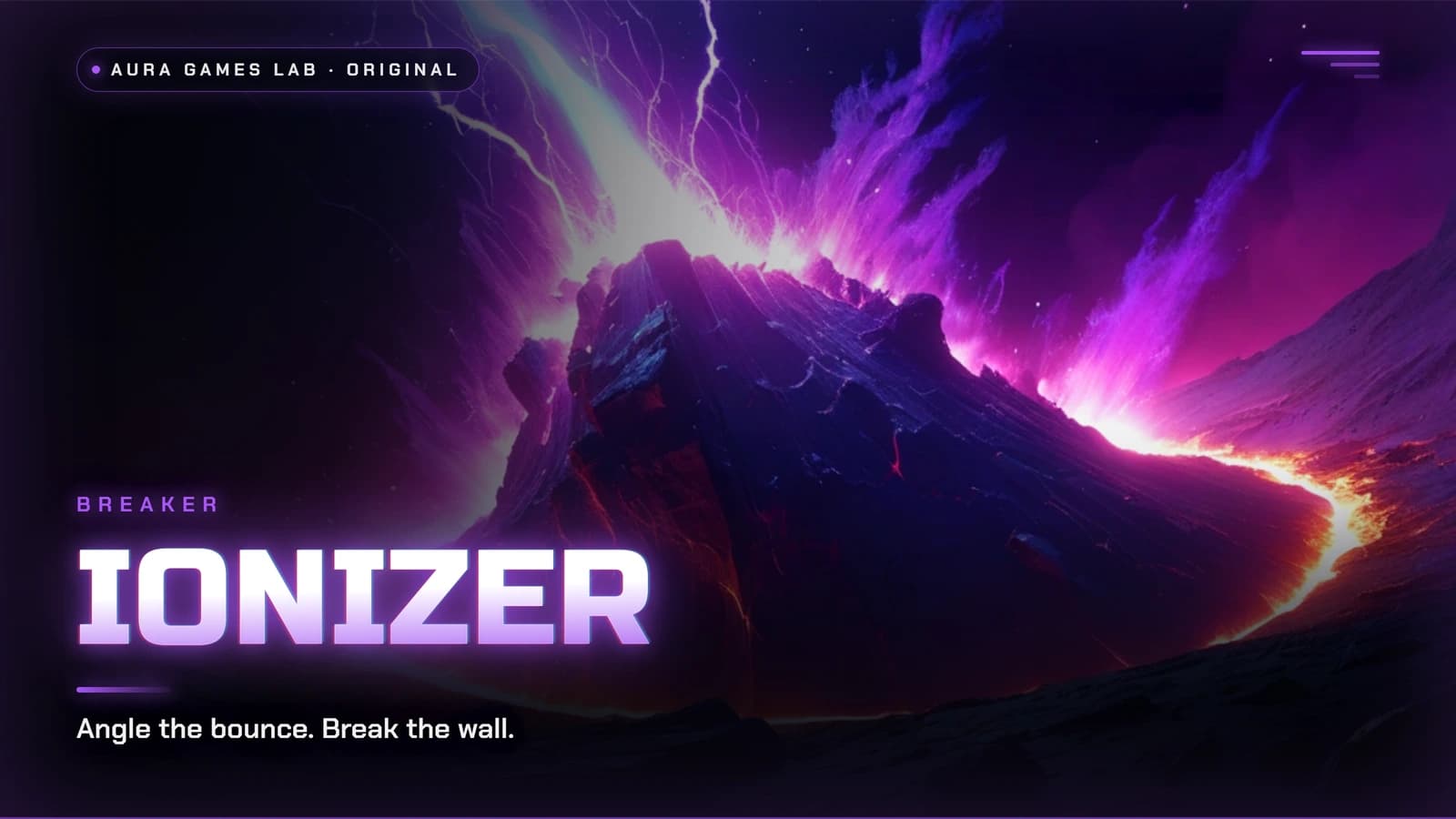
Ionizer is our brick-breaker, and we built it knowing the genre is a museum piece. The bones are older than most of the people who play them. So the question was never whether we could make another one. It was which parts of a fifty-year-old idea are actually load-bearing, and which parts are just habit we inherited. Below is the lineage, and the one place we broke with it.
1976: Breakout gets the loop right
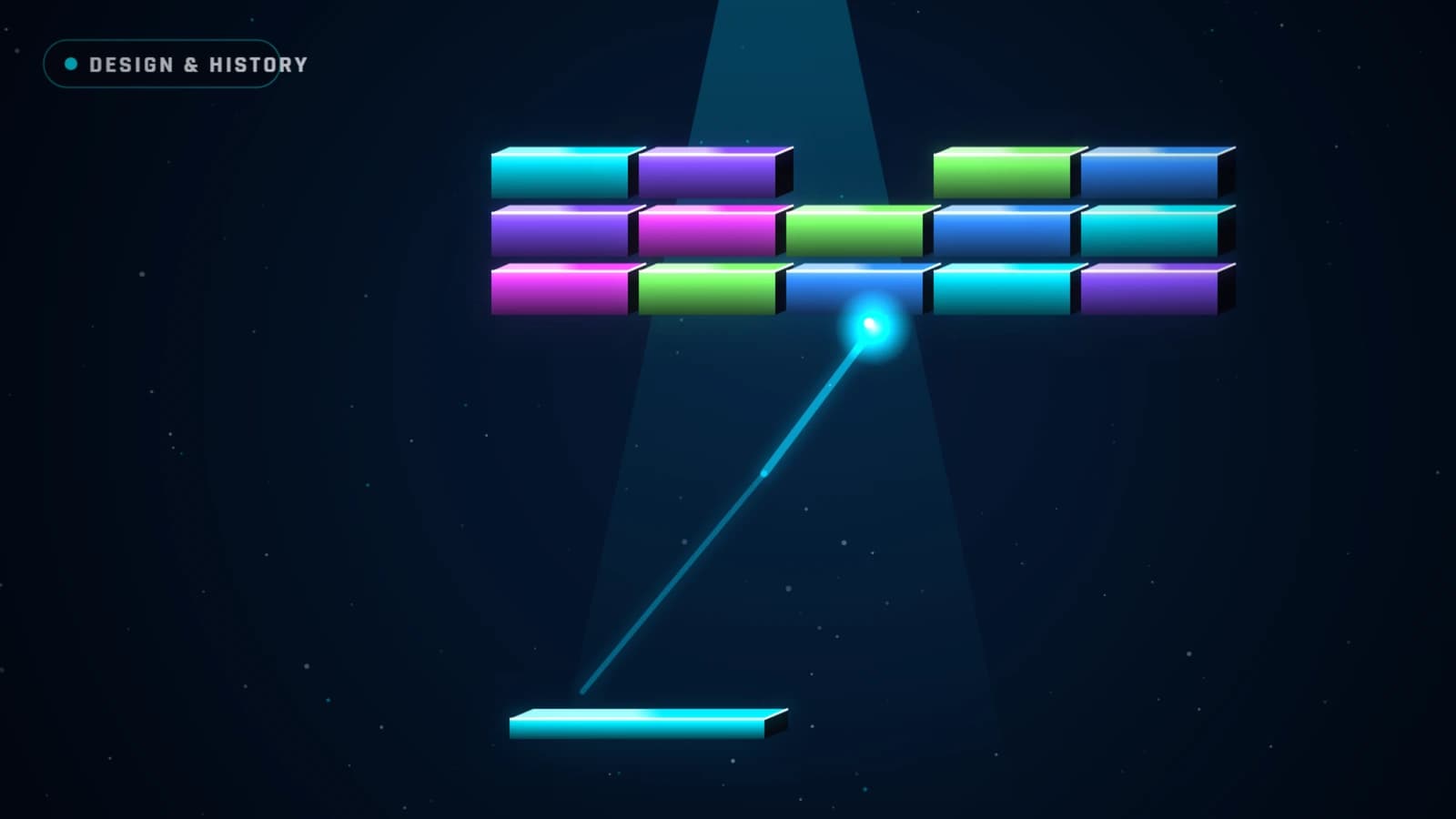
Atari shipped Breakout in 1976. The prototype ran through the hands of a young Steve Wozniak, and the design is as lean as anything in games: a paddle at the bottom, a ball, a wall of bricks at the top, three lives. Clear the wall, or run out of balls.
What Breakout got right is the thing every clone since has quietly kept. First, the ball speeds up as you dig in, so the game tightens on its own without changing a single rule. Second, and this is the one people forget: the paddle was already a steering tool, not just a wall. Hit the ball with the edge of the paddle and it comes back at a steeper angle than a centre hit. That single detail is what separates brick-breaker from Pong. It turns a reflex of "don't miss" into a decision of "where do I want this to go next." Everything we built into Ionizer's paddle is a descendant of that one idea from 1976.
Breakout also punished you for winning, in a way we still admire. Break through to the top wall and your paddle shrank to half its width. The reward for progress was a harder game. Cruel, and we still think correct.
1986: Arkanoid writes the template
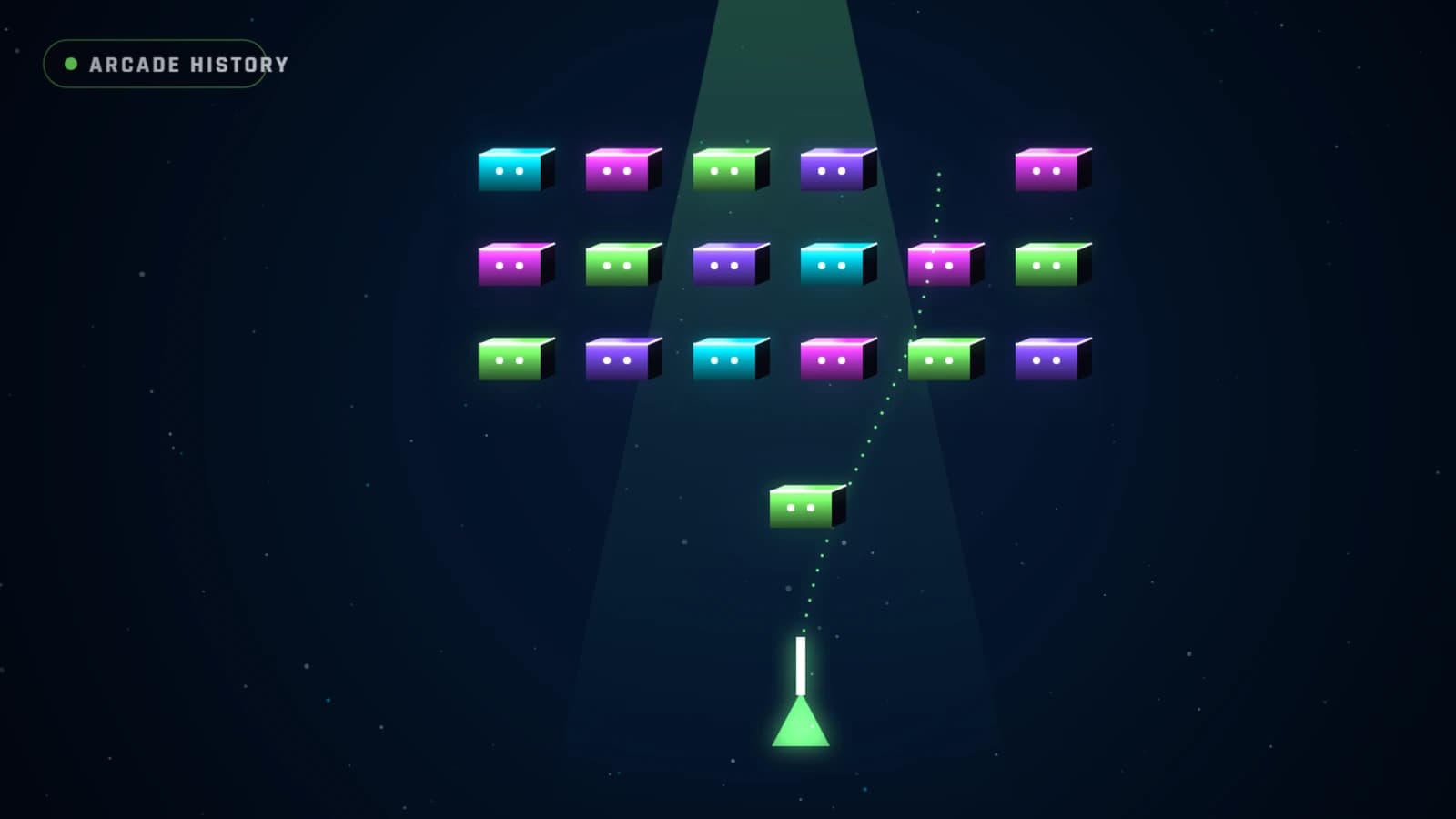
Ten years later Taito's Arkanoid took the skeleton and gave it a body. The paddle became a ship, the Vaus. Broken bricks sometimes dropped a falling capsule, and catching it changed your run: a wider paddle, a laser, a slow-down, a catch-and-aim, the dreaded multiball. Silver bricks needed several hits before they'd break, so the wall stopped being uniformly fragile. At the bottom of it all waited Doh, a boss.
Arkanoid is the version most people picture when they picture the genre, and that's the point. It set the menu everyone still orders from: capsules, bricks that take more than one hit, waves that escalate. Pick a brick-breaker off a shelf today and it's running Arkanoid's playbook, whether it knows it or not. We borrowed from it too. Ionizer's charged bricks, the ones with the bright rim that take two or three hits and darken as you chip them, are a straight descendant of Arkanoid's silver bricks. Our falling capsules are its capsules, trimmed down.
So by 1986 the genre had its shape. For a long stretch, nobody pressed hard on the one thing underneath all of it: the physics of a single bounce.
The math under a good bounce
This is where Ionizer earns the "rebuilt" in the title, because feel is math and we were willing to argue about the numbers.
Where the ball meets the paddle sets its exit angle. We take the contact point as a value from -1 (left edge) to +1 (right edge), multiply it by 1.05 radians, and add a small amount of english off the paddle's own velocity, about 0.045 radians per unit of paddle speed. Swipe the paddle left as the ball lands and the bounce leans left, on top of whatever the contact point already decided. Then we clamp the whole result at 1.35 radians off vertical. That clamp is not cosmetic. Without it, a lucky flat angle sends the ion skimming just above the paddle, alive but useless, and the run stalls into a chore. The clamp guarantees every bounce still has somewhere to go.
The other half is collision, and it's the half a weak brick-breaker gets wrong. The ball opens each wave at speed 5 and every cleared wave adds 0.6 up to a cap of 8.5. At 8.5 a ball can cross an entire brick's width inside one frame, and a naive engine lets it teleport straight through a block it should have shattered. Cheap death, and always the engine's fault. So we sub-step: each frame we measure how far the ball wants to travel and chop that path into pieces no longer than three pixels, resolving collisions on every piece. The ball never tunnels. A miss in Ionizer is yours. That was the deal we wanted to make with the player, and the sub-stepping is how we keep our end of it.
The greed layer the classic never had
Breakout and Arkanoid both score you the same way: a brick is worth a brick. Clear the wall, get the points, move on. There's no reason to prefer one order of breaking over another, no reward for style.
We wanted one. So Ionizer counts a rally. Every brick you break feeds a combo that climbs to a cap of x12, and a brick worth 10 points becomes worth 120 at the top of a chain. You don't read a number to feel it. The ion runs cool cyan when the count is low and heats toward hot orange as it climbs, its trail warming with it, and at a six-chain the whole field tips into extra bloom. The overdrive is the loudest the game ever gets, and you are the one who set it off.
The honest part of this story is that we got the rule wrong the first time, and our own maker's review of Ionizer still carries the scar. Version one tied the combo to the paddle: every brick since the ball last touched the paddle counted, and the instant it came home, the chain zeroed. Elegant on paper. In hands, unsteerable. You can't decide to keep a ball airborne; you set an angle and hope. The biggest multipliers landed as luck you noticed, not a lever you pulled, and a first-timer never twigged that catching the ball was what kept resetting them.
So we changed it. Now the chain survives a paddle bounce. It rides on a stall timer instead, refreshed to 110 frames on every break and only dropping to zero if you go too long without shattering something. The greed is the same, but the target is legible now: keep the wall breaking, don't let the ball wander an empty field. If you want the full read on steering that, the Ionizer tips guide is the strategy version of this article.
What we kept purist, and what it costs
We left a lot on the cutting-room floor. No laser, no multiball, and none of Arkanoid's gimmick bricks. The capsule layer is deliberately light: about one broken brick in six drops one, and all it can ever be is a wider paddle, a points bonus, or an extra life. Some Arkanoid fans will miss the toy box, and that's a fair complaint to have.
The bigger cost is variety, and we'll name it plainly the way our review does. Every wave is the same rectangular wall. What changes between waves is the ball's speed and how many bricks are charged to eat extra hits, nothing else. A full run gives you escalation but not surprise. We knew that when we shipped, and we made the trade on purpose: a single mechanic, tuned until the bounce feels honest in the hand, over a wall of features stapled to a loose core. It's the same bet behind Neon Stack and Aura Dash, and the same argument we have with ourselves every time we build one of these.
Fifty years on, the loop Atari found still works. The paddle is still a steering wheel. We just gave it a reason to show off. Play Ionizer and see how hot you can run the chain before the ion comes home.
Frequently asked questions
What's the difference between Breakout and Arkanoid?+
Breakout (Atari, 1976) is the stripped skeleton: a paddle, a ball, a wall of bricks, and a ball that speeds up as you dig deeper. Arkanoid (Taito, 1986) kept that core and dressed it up with a paddle drawn as a ship called the Vaus, capsule power-ups that fall from broken bricks, silver bricks that take several hits, and a boss at the end. Almost every brick-breaker since, ours included, is standing on Arkanoid's template.
How does paddle-angle physics actually work?+
Where the ball strikes the paddle sets its exit angle. Catch it dead-centre and it goes nearly straight up; catch it near an edge and it fires out sideways. In Ionizer we add a little english from the paddle's own speed, then clamp the final angle at 1.35 radians so the ball can never travel so flat it skims the floor forever.
What does Ionizer change from the classic formula?+
Three things. Collision is sub-stepped so the ball never tunnels through a brick even at top speed, the exit angle carries english off the paddle's motion, and there's a combo that rewards keeping the ball chewing the wall instead of catching it. The combo is the part Breakout and Arkanoid never had.
Does Ionizer have power-ups like Arkanoid?+
A lighter version. Roughly one in six destroyed bricks drops a capsule that drifts down for you to catch: cyan widens the paddle, amber banks bonus points, green is an extra life. There's no laser or multiball. The depth we chased lives in the paddle and the combo, not a bag of toys.