The Lost Genre of Territory-Capture Games: Qix, Xonix, and Voltex
There's a genre almost everyone born before about 2005 has played and almost nobody can name. You draw a line. You claim ground. Something chases the line. That shape has been quietly excellent since 1981, and it never got a tidy label the way "platformer" or "twin-stick" did. People call it "that Qix thing," or "the one where you cut the screen," or they just shrug. So let it have a name and a family tree, because we built a game squarely inside it and we think it deserves better than a shrug.
The rule that defines the genre
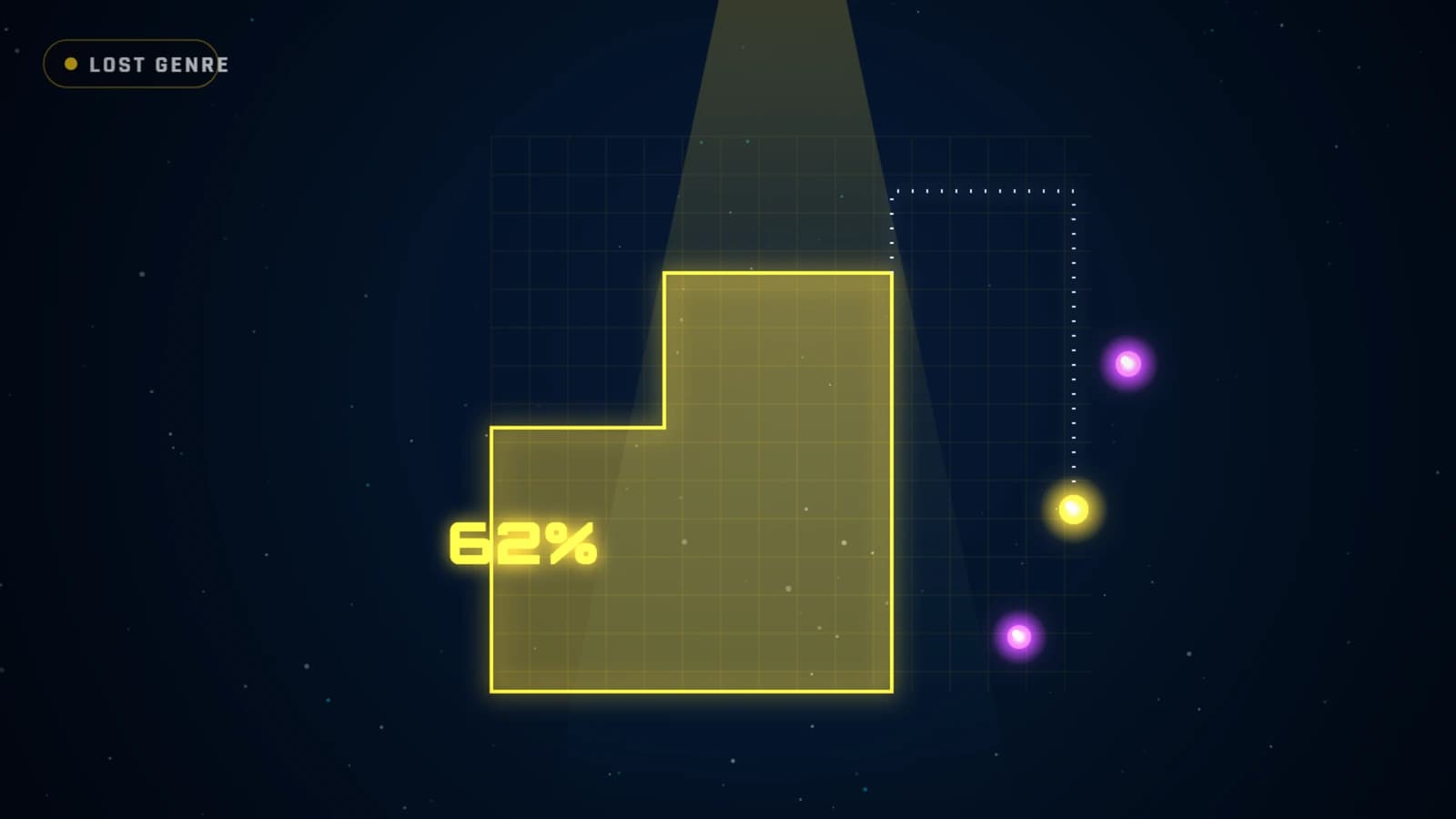
A territory-capture game hands you a point on a grid and one verb: extend. You push a trail out from ground you already own into unclaimed space. The instant you close that trail back to your own territory, the area you enclosed flips to yours. Fill enough of the board and the level ends. Fill it faster and cleaner and you score more.
The tension lives entirely in that open trail. While your line hangs out in unclaimed space, unsealed, it is the one part of you that can die. Something touches it and the run is over. So every capture is a wager. Push further and the prize grows and so does the time you spend exposed. Seal now and you're safe with less.
No shooting, no jumping. One decision, made hundreds of times a session, and it stays interesting because the board keeps changing shape under you. A single verb, and it carries a whole game.
Qix, 1981: the origin
Taito's Qix is where this starts. You control a marker on the edge of a rectangular field and draw "Stix" out into the middle to fence off sections. The thing you're avoiding is the Qix itself, a writhing ribbon of light that drifts unpredictably around the open area, backed by the Sparx that patrol the borders you haven't claimed. Seal off a chunk and it fills in solid. Claim about three-quarters of the field and you move on.
What made Qix land was the psychology of the slow draw. Inch out cautiously for tiny, safe gains, or dash out on a "fast draw" for a bigger cut worth more points. The Qix never moved predictably, so you were always reading a thing that refused to be read. Abstract, hypnotic, genuinely tense, and it looked like nothing else on the arcade floor.
Xonix and the descendants
Xonix carried the same loop to home computers and DOS, in a form a lot of people remember more vividly than Qix without ever knowing the name. Same idea, different pressure. You carve territory out of a field while balls bounce around the unclaimed space, and a separate enemy patrols the edges of what you've already taken. Get caught mid-draw, or let a bouncing ball cross your open line, and you lose a life.
From there it branched wide. Volfied gave Qix a spaceship coat. Gals Panic and its clones bolted the fill-the-board loop onto revealed background art. JezzBall ran a cousin of the idea, walling off bouncing atoms instead of drawing trails. The mechanic kept getting re-skinned because the mechanic kept working. What faded was the spotlight. As arcades gave way to consoles and everything chased 3D, the territory-grabber got shelved, not because it aged badly, but because it stopped being the new thing.
What we did with it in Voltex
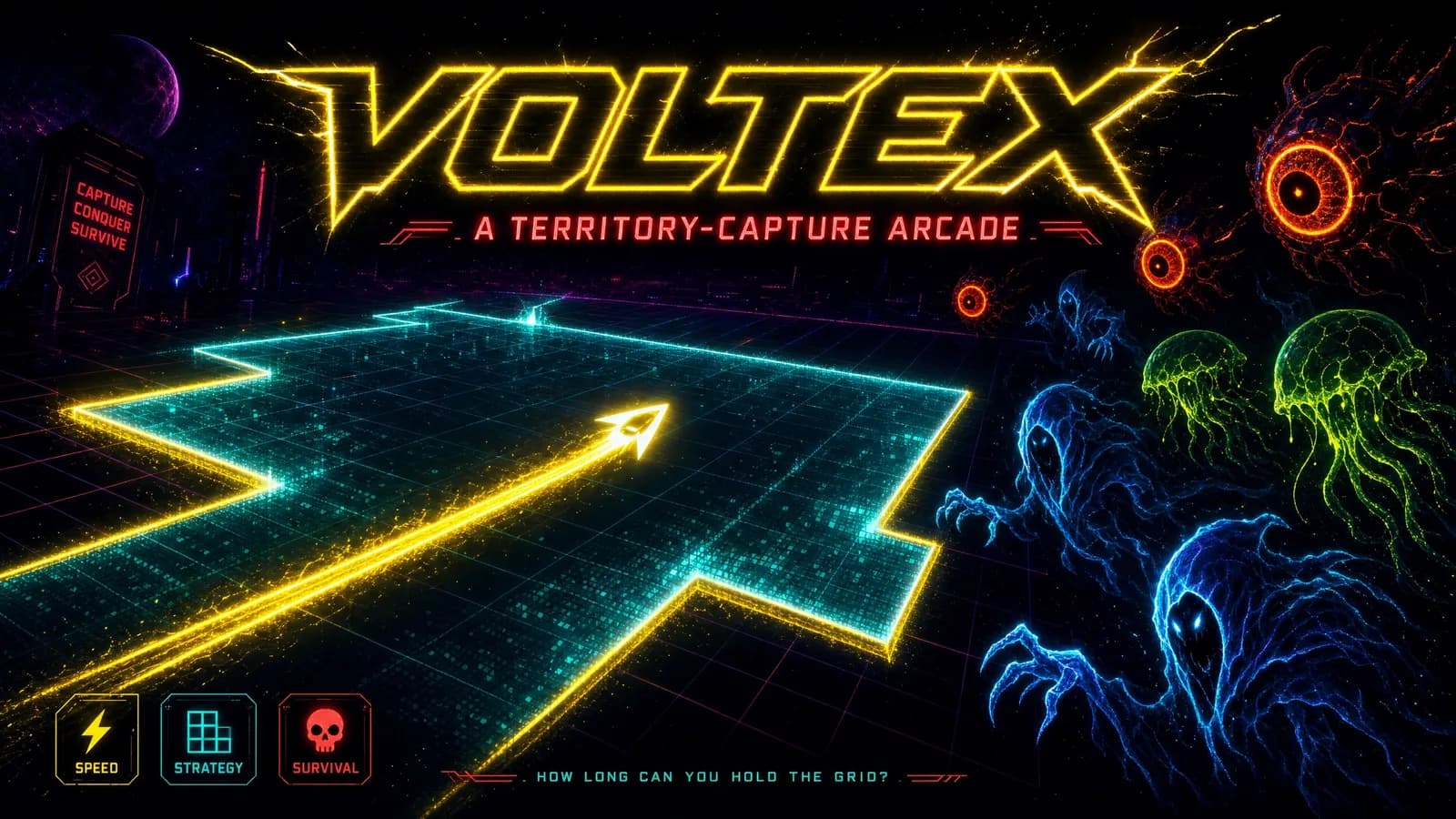
Voltex is our entry in the lineage, and we're honest about where the lineage ends and we begin. The capture loop is inherited. The neon skin and the monsters are ours. You carve a light-trail out into unclaimed grid, seal it back to ground you hold, and everything you fenced flips to yours. While that trail is open and hanging in the danger zone, a monster only has to graze it once. Greed against safety, the same nerve Qix players were pinching back in 1981.
Where Voltex earns its own place is the roster: fifteen levels, fifteen creatures, each asking for a different answer. The difficulty doesn't come from enemies simply moving faster as you climb. It comes from behaviour. One wanders like it forgot you're on the board. Another turns toward your trail the moment you open it. Qix pointed a single unpredictable antagonist at you; we spread that unpredictability across a ladder of fifteen, so reading the enemy before you commit becomes the running skill instead of a one-time lesson.
The mystery crates are a push-your-luck layer over the classic fill loop. They drop power-ups, and they pay off most in the opening stretch of a level, while the grid is still wide and there's clean board to spend them on. Sit on one until things get cramped and whatever it hands you has nowhere useful to go.
We'll name the rough edges too, the way we do everywhere. Voltex shipped before we'd settled the sound-and-juice standard our newer originals run on, so next to something like Aura Dash it plays a touch plainer. It also lives on its own domain at voltexgame.com, which sends a header that blocks embedding, so it opens in its own tab rather than running inline here. That's friction we spend most of our days scrubbing out. We'd rather point you to a good territory-grabber honestly than hide it because the packaging isn't perfect.
Why the genre is worth reviving
Three reasons, and none of them nostalgic.
Start with onboarding, which is nearly free. There's no move list to memorize. You draw a line, you close it, you get ground. A total stranger understands the objective inside one capture, and that clarity is exactly what we chase across the whole studio.
Then the decision, which is real. Most casual games hand you a reflex test with no genuine choice inside it. Territory capture is built on an actual dilemma: how greedy do you get before you run home? A good player and a bad player make visibly different bets on the same board, and that's rare in a format this easy to pick up.
And the death is diagnostic. Lose a level in Voltex and you almost always know the exact pattern you misread, the precise corner you trusted that you shouldn't have. That's what makes a retry feel earned rather than cheap. We went after the same honesty in Ionizer, where a dropped ball traces back to a paddle angle you can see in hindsight, never the engine robbing you.
If that greed-against-safety nerve is what pulls you in, we've wired the same dare into more than one game. Aura Dash pays you for grazing a shard instead of fleeing it, so the safe path and the stylish one finally split apart. Neon Stack tempts you to chase a dead-centre perfect for the width it hands back, right when playing safe for a sliver of overlap is what would keep your tower alive. Different verbs, one idea the old territory games understood first: the safe line and the rich line are not the same line, and the whole skill is knowing the gap between them.
Where to start
If you've never knowingly played one of these, you almost certainly have anyway, under some name you've forgotten. The quickest way to feel why the genre outlasted four decades of neglect is to draw one trail and get greedy about it. When you want to go deeper, our Voltex tips guide breaks down how to hold all fifteen levels: claim in small bites, seal the instant a monster nears your open line, and read each creature before you commit.
Play Voltex and see how much of the grid you can hold.
Frequently asked questions
What is a territory-capture game?+
It's an arcade format where you don't shoot or jump. You draw a line out from safe ground into open space, then close that line back to territory you already own, and everything you fenced off becomes yours. You win by claiming enough of the board, usually while enemies try to catch your line before you seal it. Qix (1981) is the template; Xonix and our own Voltex run the same loop.
What games are like Qix?+
Xonix is the closest classic cousin. Beyond it there's a long line of descendants: Volfied, Gals Panic, JezzBall. The loop stays the same: extend a trail, close it around open ground, claim what you enclosed, and keep it away from whatever is hunting your open line. Voltex is our neon, monster-heavy take on that format, with fifteen levels and fifteen creatures.
Where can I play Xonix online?+
Xonix itself is an old DOS-era title that survives through browser ports and emulators of varying quality. For the same territory-grab loop built for a modern browser tab, Voltex is our version. Fair warning: Voltex opens in its own tab rather than running inline, because its host domain blocks embedding.
Why did territory-capture games nearly disappear?+
The format peaked in arcades and on early home computers, then got crowded out as shooters, platformers and 3D took the spotlight. The loop never stopped being good. It just stopped being fashionable, which is exactly why it's worth another look. You get one clean rule and a real greed-versus-safety decision, with no tutorial to sit through.