From Simon to Echo: A Short History of Memory Games
We have written a few of these genre histories now: what a formation shooter actually is, the line from Breakout to our brick-breaker, the territory-capture lineage that runs Qix to Xonix. Each traces an old arcade shape down to a game we built on top of it. This one is about the smallest, oldest shape of all: watch a sequence, repeat it, do it again one step longer. The memory game. Its founding object is a plastic disc from 1978, and the version we shipped is four buttons in a browser tab called Echo.
1978: a plastic disc at Studio 54
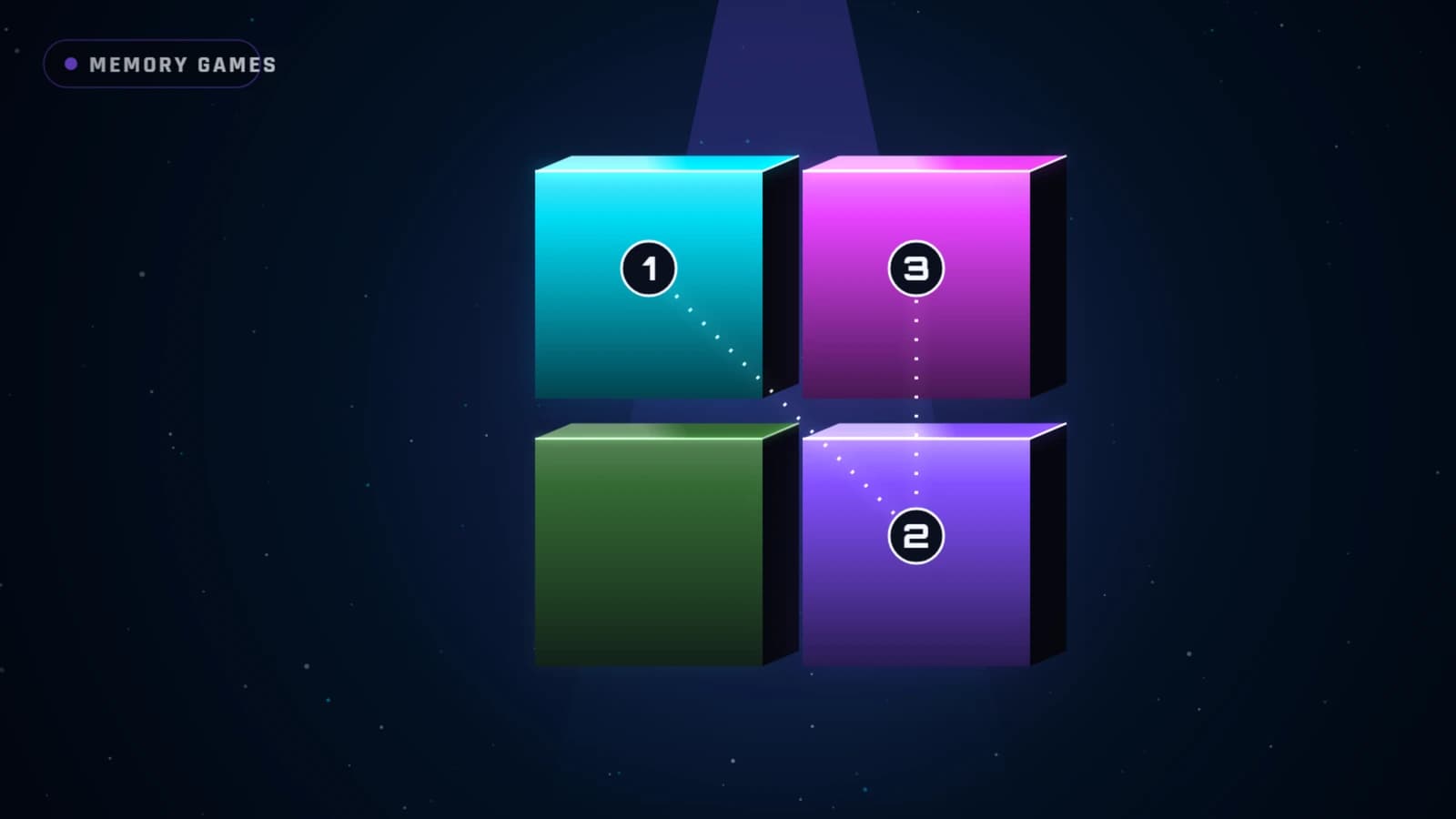
Milton Bradley launched Simon in 1978 with a midnight party at Studio 54, which tells you it was pitched as much as a social object as a toy. Ralph Baer, the engineer behind the first home console, co-designed it with Howard Morrison after Baer came across an Atari coin-op called Touch Me and figured the idea deserved better hardware. Touch Me got there first. Simon gave it four fat colored buttons, a satisfying tone under each one, and a shape you could read from across a room.
The rules fit on a matchbook. The machine flashes a light and plays its tone. You press that button. Then it flashes two, and you press both, in order. Then three. Every round it replays the whole sequence and tacks one new step on the end, a little faster as you go. Miss a single button and it buzzes at you, and the run is over. No lives, no partial credit. Whatever you built that round doesn't carry.
That refusal to hand anything back is the engine of the whole thing, and it rewards a second look. Almost every game gives you a soft landing. Simon does the opposite. It ends you exactly one step past your ceiling, on a sequence you had watched a dozen times and nearly held. You do not lose because the game got clever. You lose because you were carrying nine things and it asked for ten.
Why the escalating sequence never wears out
This format has survived nearly fifty years without a single mechanical revolution, and the reason is that it is tuned to a hard limit in the human head. Short-term memory holds a famously small number of loose items before they start falling off the back, usually somewhere around six or seven. A flat list of colors overflows fast.
So the game becomes a fight to beat your own hardware. Good players do not have better eyes. They have better encoding: they chunk the sequence into small groups and name it as a story instead of holding raw positions. That is the skill layer hiding under a toy that looks like it has none. And because the difficulty climbs by exactly one step, the distance between "amazing run" and "dead" is always a single flash. The margin never widens. Nobody has improved on its bones, because there is nothing structural left to fix.
What people forget is that Simon was never only about color. Each of the four buttons sang a fixed tone, so a sequence had a shape you could hum, not just a pattern you could see. Baer understood that sound is memory glue. A tune sticks where a list of directions slides off. That is the seam we pried open when we built ours.
Echo: the same skeleton, retuned
Our own maker's review of Echo says it plainly, so we will too: this is Simon. We were not out to reinvent a 1978 toy. We wanted the best-feeling version of it that opens in a browser tab, with no download and no second website in the way. The whole game is four DOM buttons in a 2x2 grid. No canvas, no engine. Stripping it that far was deliberate, because it forced every scrap of the feel into places you cannot see.
The place it went was sound. Each pad owns one note, and the four are chosen, not arbitrary. C4, E4, G4 and A4, sitting at 261.63, 329.63, 392.00 and 440.00 Hz, together spell a C major sixth chord. The point of picking those four is that they are consonant in every order. Whatever random sequence the game fires, it resolves as a small, pleasant melody instead of a sour jumble of beeps. A clean run is, quite literally, you composing a short tune without meaning to. Simon paired each color with a tone. We picked the tones so they would always agree with each other.
Around that we added what the plastic disc physically could not carry. A row of progress pips shows how deep the current sequence runs and fills as you tap, so you always know your position in the list. When playback ends, a pulsing "your turn" badge marks the handoff, which kills the classic Simon mistake of reaching for a pad before the sequence has finished. Climb toward round 20 and the pads glow harder while the palette warms, a reward that does nothing mechanical and everything emotional. Anyone whose OS asks for calm gets a full reduced-motion path that quietly drops the shockwave rings and pip animations.
The pacing follows one honest rule. Playback opens loose, near 600ms a step, and tightens 24ms every round, bottoming out at 280ms once the sequence runs about fifteen steps deep. Past that floor nothing gets faster. The only thing still growing is how much you are holding in your head at once, which is the exact wall the whole genre is built around.
Where the format hits its ceiling, honestly
We are not going to oversell a shape this old. Echo's honest flaws are the genre's flaws, and we named them when we shipped. There is no new mechanic here. It is a polished Simon, and we will not pretend otherwise. The difficulty runs on a single axis, because once the speed floors out around round 14, memory load is the only thing left climbing. Since the sequence is random, there is no strategy to dig up, only recall. And one wrong pad ends the run outright, a detuned buzz and a shake, no second chance. That punish-and-restart loop is faithful to 1978. It is also the thing most likely to make you close the tab instead of hitting play again.
We think the trade is worth making for a game you can start on a whim with a mouse or a thumb. The reason we keep the library small is so each of these gets the tuning a two-minute game actually needs, down to which four notes ring when you tap.
If watch-then-repeat calm suits you, the other shelf-mate we keep open in a tab is Nova, which pushes on reaction instead of recall: neon rings bloom and shrink, and you pop them before they vanish. Different muscle, same idea of one clean rule taken seriously. But if you want the format that has outlasted nearly every console it shared a shelf with, play Echo and find out how long your melody gets before your memory drops a note.
Frequently asked questions
Who made the game Simon and when?+
Milton Bradley launched Simon in 1978, famously with a midnight party at the New York disco Studio 54. It was co-designed by Ralph Baer, often called the father of video games, and Howard Morrison, and it drew directly on a 1974 Atari coin-op called Touch Me. Four colored buttons, each with its own tone, an escalating watch-and-repeat sequence, one miss ends it.
Why are memory games like Simon so addictive?+
The escalating-sequence format grows the challenge by exactly one step at a time, so every failure lands a single rung below a number you know you can reach. That 'one more go' pull is structural, not accidental. You always lose to a length you nearly held.
Do the pads in Echo actually play musical notes?+
Yes. The four pads are tuned to C4, E4, G4 and A4 (261.63, 329.63, 392.00 and 440.00 Hz), which together spell a C major sixth chord. Because those four notes are consonant in any order, a random sequence still plays back as a small melody instead of a beeping mess.
How is Echo different from the original Simon?+
Same skeleton: four pads, watch, repeat, one longer each round. Echo adds things the 1978 toy could not do in a browser tab, including progress pips that show how deep the sequence runs, a pulsing 'your turn' cue, a glow that warms as you climb, and a full reduced-motion mode. We picked the four notes to always harmonise.