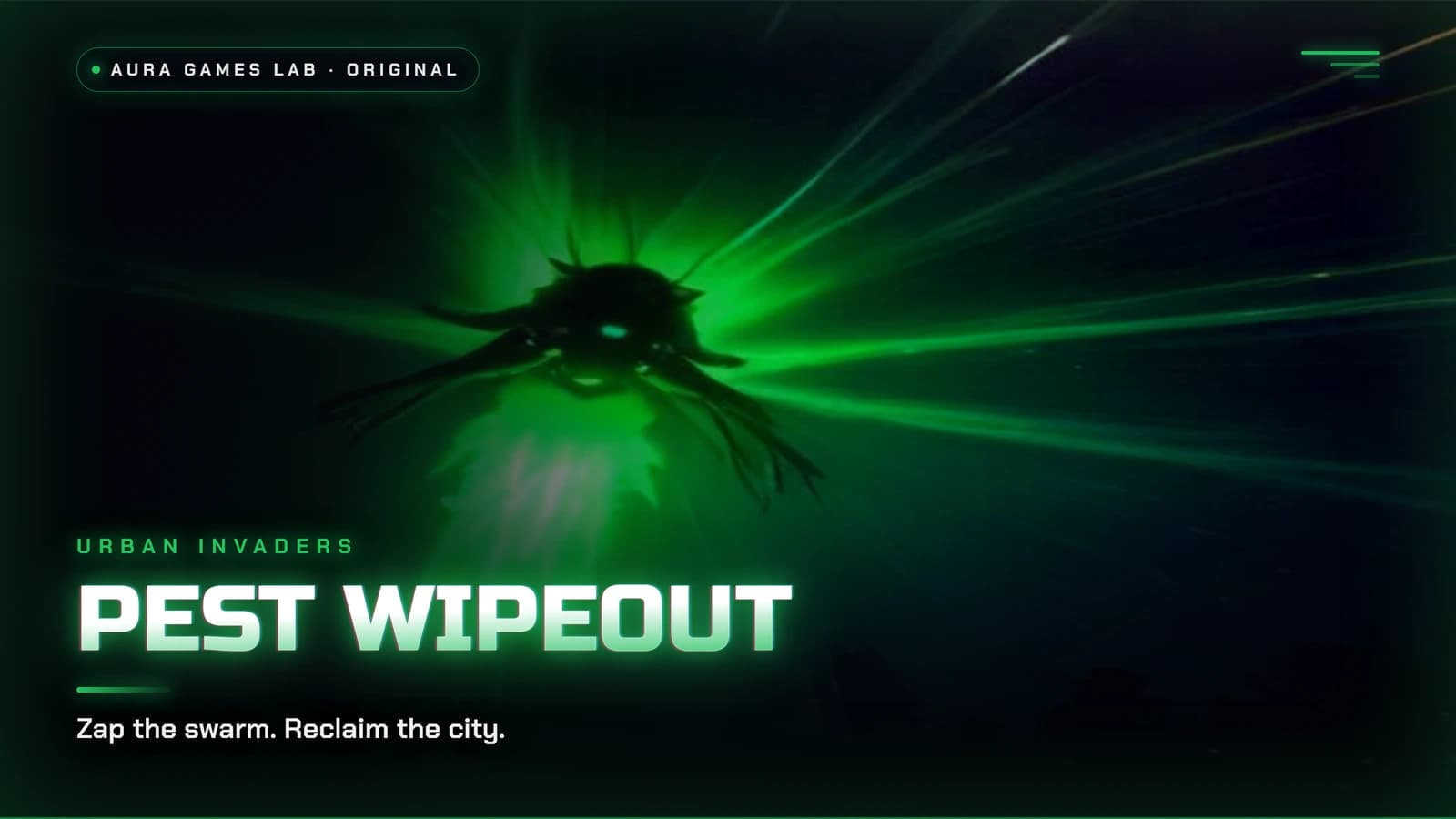
What Is a Formation Shooter? From Space Invaders to Pest Wipeout
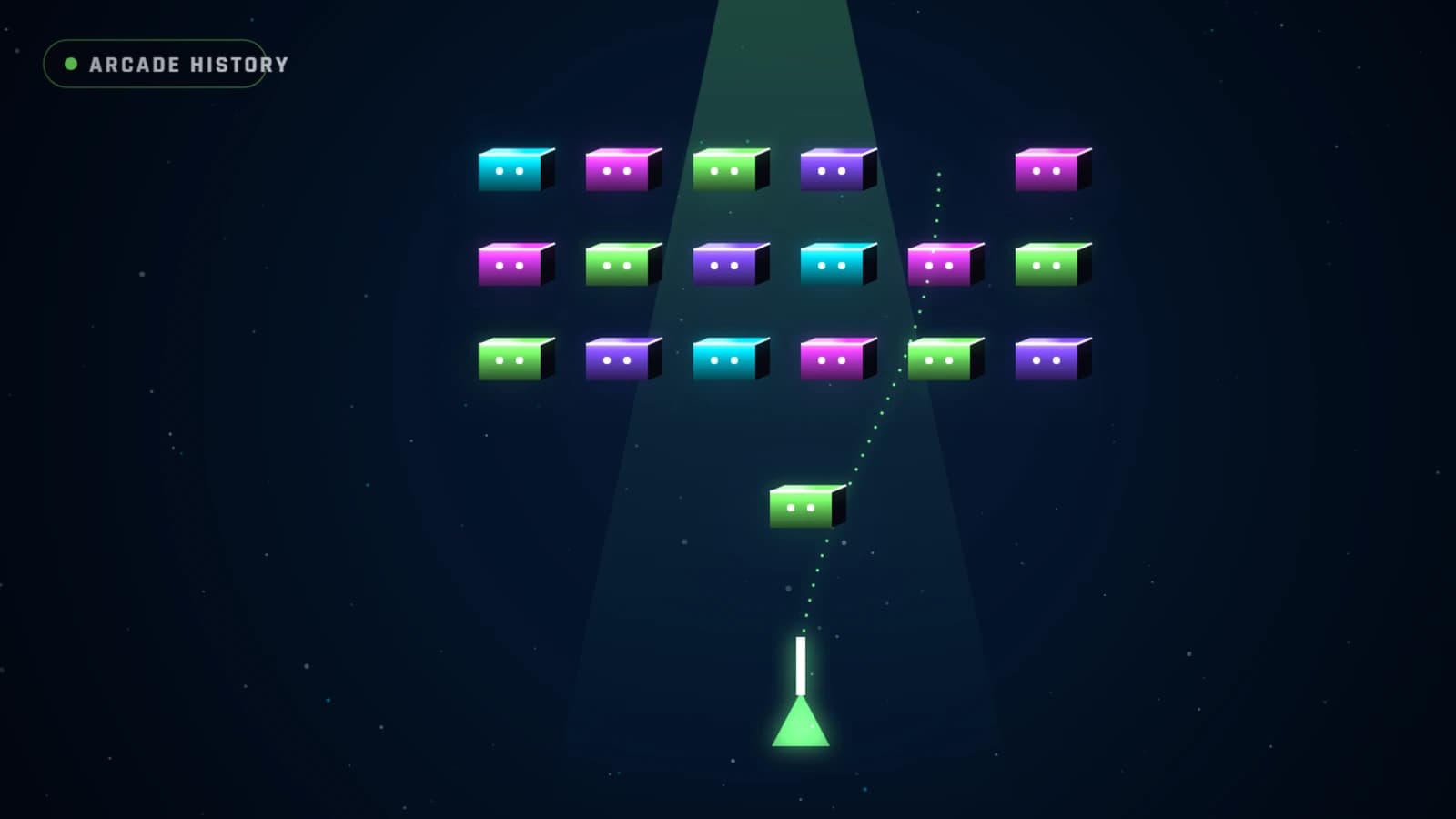
A formation shooter is easy to recognise and weirdly hard to define. You sit at the bottom of the screen. A crowd of enemies flies in from the top, arranges itself into a tidy pattern, and starts drifting toward you while individuals break off to attack. You shoot up; they shoot down. That shape has barely changed in almost fifty years. What changes is how much a studio understands about why the shape works.
We build browser arcade games for a living, and one of ours, Pest Wipeout, sits squarely in this tradition. So here is the family tree, from people who had to pull the genre apart before rebuilding it, plus an honest note on where our own game lands in it.
The formation is the whole idea
Space Invaders (Taito, 1978) is the ancestor, and it already had the one mechanic that names the genre. Those five rows of aliens are not a random spawn. They march sideways in lockstep, drop a rank when they hit the edge, and speed up as you thin them out, so the last few are the fastest and scariest. The formation is a single organism you dismantle from the outside in.
That is the quiet genius nobody credits. A scatter of enemies is just noise to react to. A formation is a shape with structure, which means you can read it and carve it in an order you choose. Take out a column and you open a firing lane. Leave the edges and the whole block speeds up on you. Every formation shooter since has kept that bones-deep rule: the enemies mean more together than apart.
Galaga taught the swarm to dive
Namco's Galaga (1981) added the second pillar. Instead of the whole block grinding down at you, enemies flew on-screen in looping entry paths, settled into a grid at the top, and then peeled off one or two at a time to dive-bomb your position before curving back to their slot. Suddenly the formation was a home base the swarm launched from, not just a wall creeping closer.
This is the moment the genre got its tension. A resting formation is a target. A diving enemy is a threat. You are always doing two jobs at once: chewing the grid down while tracking whoever just broke off to come kill you. Galaga even let a captured ship become a second gun if you rescued it, the sort of risk-for-reward wrinkle the genre has chased ever since.
Chicken Invaders made it a comedy with an arsenal
By 1999, InterAction studios' Chicken Invaders proved the skeleton could carry a joke and a progression system. The aliens became chickens. Waves came in a numbered stream, dropped food and gifts when they died, and those gifts fed a weapon that climbed from a single peashooter to an absurd screen-filling spread. The march-and-dive core was untouched. What got bolted on was escalation you could feel, plus a tone that did not take itself seriously.
Wave structure, a weapon that visibly grows, a theme that jokes: that mix is the template most modern formation shooters copy, ours included. It is why the genre reads as friendly rather than punishing. You are not just surviving, you are getting stronger between waves and you can see it happen.
Where Pest Wipeout sits in the line
We built Pest Wipeout knowing exactly which shoulders it stands on, and it wears the inheritance plainly. You pilot a neon bug-zapper along the bottom and HOLD to fire straight up. The pests fly in, lock into a sweeping formation (tidy grids early, then rings, vees and diamonds), sway and descend, then peel off one at a time to dive at you. Kills drop green spray-can gifts that climb your weapon from a single pulse to a screen-wide eight-way spread, exactly the arsenal arc Chicken Invaders popularised. Every fifth wave is a multi-phase boss with a health bar and shield pips.
The idea we care about most is the teaching structure. Every wave introduces ONE new pest before it starts mixing them, so you meet each threat clean: zig-zagging cyan mosquitoes first, then looping houseflies, armored purple roaches that soak three hits, wasps that spit golden stingers, and finally crows that swoop on heavy black wings. Space Invaders and Galaga hand you the whole cast at once and let you sort it out. We drip-feed the roster so the difficulty comes from combinations you already understand, not from surprise. By the time a mixed wave arrives, you have already learned every animal in it.
Then there is the greed layer the old games only hinted at. Your combo multiplies every kill and never hard-caps, but it breaks the instant you take a hit, and that same hit knocks your weapon down two levels. A base mosquito is worth 6 points, a roach 22, and a clean wave at a high combo is worth many times a sloppy one. So your weapon level is really a second health bar you have to defend, a risk-and-reward read Space Invaders never asked for. We wrote a full tips and boss guide on how to hold that line if you want the deep version.
The two problems the genre never solved
Being honest about the lineage means naming what it always got wrong, because we inherited both flaws and had to fix them.
The first is unfairness. Classic formation shooters love a wall of fire, and a death often feels like the screen ganging up rather than a mistake you made. Our early builds had exactly this sin. We killed it by telegraphing everything. A dashed line traces precisely where a diver will go before it commits. A yellow warning triangle flags any pest about to shoot. And for the first couple of waves, only one attacker comes at a time. Add 1.2 seconds of blinking invulnerability after each hit and a death stops being a cheap shot. It becomes a read you lost. Tough, but fair.
The second problem is that the targets are boring. Nobody feels anything vaporising a pixel alien or a cartoon chicken. That was the joke that started Pest Wipeout: everyone has wanted to swat a mosquito at 3am, so we pointed the whole genre at the pests a city summer actually produces. The core loop is decades old and we will not pretend otherwise. The theme is ours, so is the fairness, and so is the cel-shaded art that's drawn in code rather than stamped from a sprite sheet.
What a formation shooter is not
The label gets stretched, so a quick boundary. If your ship flies through a scrolling level dodging dense curtains of bullets, that is a bullet-hell shmup, a cousin with a different heartbeat. If enemies appear one at a time with no shared pattern and you just react to each, that is a reaction game, closer to our Nova, where neon rings bloom and shrink and you pop them before they vanish. A formation shooter needs the formation: a coordinated shape that arrives, holds, and launches. No shape, no genre.
That shape is why these games have lasted since 1978. A formation is the rare enemy that is more interesting to look at than to shoot, because looking at it tells you the order to shoot it in. Space Invaders found that by accident. Galaga turned the resting grid into a launch pad, Chicken Invaders wrapped the whole thing in a joke, and we spent our years on the part everyone skipped: making a death feel earned. Same swarm, four decades apart.
Go meet the pests and see how much of the lineage you can feel in the first three waves.
Frequently asked questions
What makes a game a formation shooter?+
Enemies fly in and lock into a coordinated pattern (a grid, ring, vee or diamond) that sways and slowly descends, and you shoot from a fixed position along the bottom. The formation is the point: it gives you an ordered shape to carve instead of a random scatter of targets. Space Invaders started it in 1978, and every game in the line since has kept that skeleton.
Is Pest Wipeout basically Chicken Invaders?+
It shares the core loop, and we say so openly. The difference is the target and the fairness. You shoot the pests everyone actually wants dead (mosquitoes, roaches, wasps, crows), and every dive draws its path while every shot flashes a warning first, so late-wave deaths are yours to own. Same core loop, a very different skin, and a much fairer read.
What's the difference between a formation shooter and a bullet-hell shmup?+
A bullet-hell is about weaving through dense walls of projectiles, usually while your ship scrolls through a level. A formation shooter keeps you locked to the bottom against enemies that hold a visible pattern, and the skill is in reading and dismantling that pattern before it dives. Pest Wipeout is firmly the second kind.
Do I need to download anything to try one?+
No. Pest Wipeout runs in the browser tab on this domain, on a mouse or a thumb, with nothing to install. If you want the pure reflex core without the formations, Nova is a lighter one-tap reaction game from the same studio.