One Tap, One Button: Why Minimal-Control Games Are So Hard to Put Down
The pitch for a one-button game fits on a napkin. Tap to drop a block. Tap to fly up. Anyone gets it in the time it takes to read the sentence, and that is the trap: a game you can explain that fast sounds like a game you can exhaust that fast. We built two of them and found the opposite. The single input is the easy part. What keeps a thumb on the screen is the sliver of precision hiding behind it.
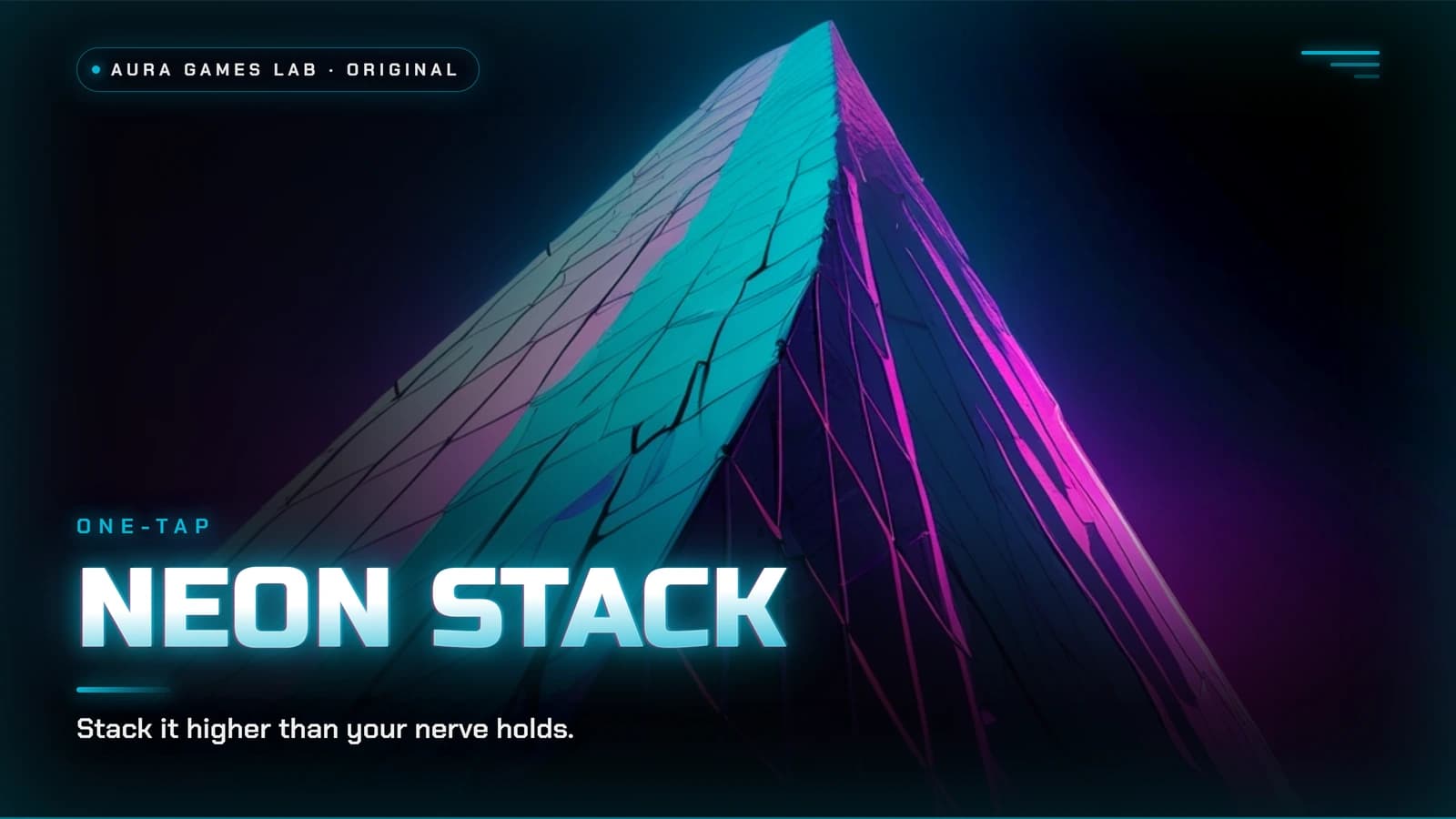
We make Neon Stack and Flux, and they sit at opposite ends of what one button can mean. Neon Stack is a tower-stacker: a glowing slab slides side to side, you tap to drop it, and any overhang gets sliced off. Flux is a flyer: tap to pulse upward, gravity pulls you back, thread the gaps in a wall of neon gates. Same count of inputs, nothing else alike. Set them side by side and you can see why minimal-control design keeps its grip, and where the skill actually lives.
The whole game is a window you can't see
Every good one-tap game hides a scoring window smaller than the input that triggers it. You press one button, but the button only pays off inside a band of time or space most players never consciously measure.
In Neon Stack that band is six pixels wide. Drop the slab within 6px of dead-centre and it snaps flush to the block below, hands back up to 4px of the width you'd lost, and bumps your combo. Miss centre and you keep only the overlap: the combo falls to zero and the tower narrows toward nothing. Six pixels is the whole difference between a run that rebuilds itself and one that whittles away. Nothing on screen draws that window as a hard edge. You feel for it.
Flux hides its window in space rather than at a point. Clear a gate within 20% of the gap's centre and you open a perfect-thread streak; drift off by a hair and it snaps back to zero. The cruel part is geometric. The gaps start at 210 pixels and pinch 3px with every pass, down to a 132px floor, so the centre band you're aiming for gets thinner at exactly the moment the urge to chase it bites hardest. You're threading a needle that keeps shrinking while someone speeds up the thread.
Same idea holds under both games. The input is honest and obvious; the reward lives in a tolerance you have to develop a feel for, because we deliberately didn't paint it as a line.
One button, two totally different clocks
Where the games split is time. Neon Stack is discrete. Every drop is a self-contained timing test with a clear start and finish, and between drops you get a breath to read the next one. Flux never stops. There's no rest frame. One tap sets your vertical speed to -6.4 and gravity drags it back at 0.42 a frame, so altitude is something you feather constantly and never hold. You aren't making a decision so much as holding one steady.
That changes what getting good even means. In Neon Stack, skill is a clean twitch repeated. Speed starts at 3.4 pixels a frame and climbs 0.16 with every slab to a hard cap of 8.5, and by the top of that ramp the 6px window is barely wider than a single frame. It's why our own tip tells you to release a hair before the slab looks centred. Late in a run you're outrunning your own reaction lag. The slab isn't faster than you can see; it's faster than you can respond to what you saw.
Flux wants something else. Scroll speed drifts from 3.1 up to a 6.2 ceiling while the gaps keep tightening, so the game asks for a steady cadence of small pulses rather than one heroic input. A player who yo-yos between ceiling and floor dies. A player who taps in a light, constant pattern threads gate after gate. The mastery lives in the wrist.
Both are one button. One rewards a sniper, the other a metronome.
Why the skill has to be invisible
We keep bumping into one design tension, and we haven't fully solved it. The thing that gives a one-tap game depth is exactly the thing a new player can't see. Slap a giant PERFECT ZONE bar across the screen and the game reads easier and feels cheaper, and the satisfaction of finding the window by feel evaporates. So the depth stays quiet. The risk is that it stays too quiet.
Flux is our cautionary tale. The perfect-thread streak is the best idea in the game, a real risk-reward call bolted onto a loop most one-button flyers leave bare: fly wide and live, or hug the centre and get rich, since five clean threads in a row compound into a bonus that dwarfs safe flying and tips the field into overdrive. And a player who never watches the score can beat the game without ever learning that layer is there. No streak counter, no callout when the number jumps by six instead of one. We under-sold our own best mechanic, and we know it.
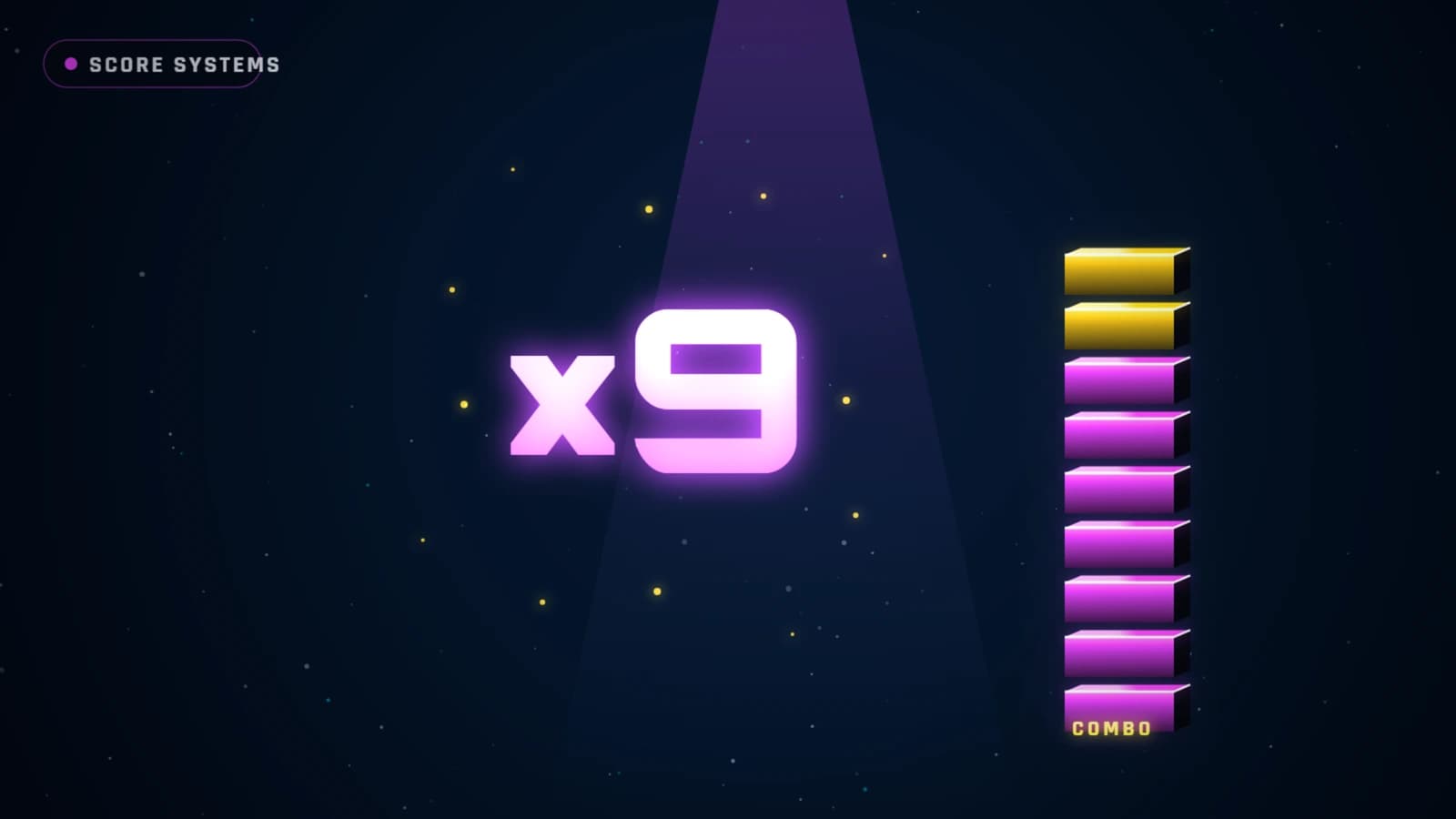
Neon Stack handles the same problem better, because its depth has a face. The scoring rewards nerve out in the open: a perfect pays 1 plus your current combo, so five clean drops in a row bury any lucky single, and the board answers by glowing brighter per perfect until a combo past 5 tips the whole thing into an overdrive bloom. You don't need to read a number to know a streak is worth defending. The screen gets hotter. That visible heat is how a hidden window earns a visible reward, and it's the piece Flux is missing.
Neon Stack also carries the clearest motivator we've built for a minimal game: a dashed BEST line. Score outruns physical rows, so we track your best height in rows separately and paint it across the board as a target. The slab that finally clears it flips the line from cyan to gold and the tower throws a little party. One button, one number to beat, always on screen. That's the honest version of what Flux does silently.
The catch we'll own
Minimal control has a ceiling problem, and both games hit it. Neon Stack only ever changes pace, never shape, so slab 40 is the same 6-pixel test as slab 8, just faster. Flux flatlines once the gaps reach their 132px floor and the speed caps at 6.2, and long runs sink into rote maintenance. A single input hands you a low skill floor for free. It doesn't hand you a high ceiling to match, and the difficulty math has to build that by hand. When it stops writing new pressure, the game coasts.
We think both earn their place anyway, because the twenty-second version of each is genuinely hard to set down, and that's the real measure of the form. A one-button game doesn't win on depth of systems. It wins on the quality of a single moment repeated: the exact weight of the drop in your hand, the exact feel of a pulse that lands you dead-centre. Get that moment right and the napkin pitch stops being a limit. It becomes the reason you tap one more time.
Play them back to back. Neon Stack for the sniper's twitch, Flux for the metronome's patience. Same button, two entirely different kinds of good.
Frequently asked questions
What actually makes a one-button game addictive instead of boring?+
A tiny window of precision hiding behind the simple input. In Neon Stack the whole game turns on landing a drop within 6 pixels of dead-centre. In Flux it's threading a gate within 20% of the gap's middle. Easy to start, and that window is what you spend the next hundred runs learning to feel.
Are one-tap games too simple to have real skill?+
No. Simple input is not the same as simple game. Both of ours make you time a single press against numbers that move: a 6px scoring window as the slab speeds toward 8.5 pixels a frame in Neon Stack, and a shrinking gap that pinches to 132px in Flux. The button is easy. Hitting the window is not.
Which is harder, Neon Stack or Flux?+
Different kinds of hard. Neon Stack is one precise moment repeated: each drop is its own timing test. Flux is continuous, since you feather altitude every frame while aiming for a centre band that keeps shrinking. Neon Stack punishes a single twitch. Flux punishes a lapse in rhythm.
Do minimalist games work on a phone?+
They're built for it. One input maps cleanly to one thumb, with nothing to install. A tap drops the slab in Neon Stack or pulses you upward in Flux, and both run right in the browser tab with sound and reduced-motion support.